I. Team Overview
The team conducts research oriented toward practical problems and core technologies in the development of the logistics industry, exploring diverse logistics solutions that are both innovative and effective by integrating fundamental theories with applied practices. Guided by the principle of “maximizing the utility of goods, ensuring smooth flow of cargo, enabling seamless commerce, and integrating trade with finance,” and aiming to “redefine logistics thinking, construct new industrial models, unlock new value in logistics, and reshape the industry ecosystem,” the team strives to become a leading research group in the field—recognized both by industry and academia—for comprehensive, full-scenario logistics innovation. The team’s primary research directions mainly include the following five aspects.
1. Logistics Industry Planning and Supply-Demand Balance Theory
Addressing the needs and pain points in regional logistics development, logistics park construction and operation, and enterprise-level logistics industry growth, the team carries out research on logistics industry planning. By analyzing policy orientations, industry trends, and market environments, it innovatively designs industrial systems and business models, constructs logistics network models, and proposes implementation methodologies and safeguard mechanisms for logistics industry operations, thereby establishing a systematic and highly applicable planning methodology. In addition, the team investigates theoretical issues related to supply-demand balance in logistics markets and develops demand forecasting models for the logistics industry, providing strong support for planning and implementation.
2.Smart Logistics Digital Platform Design and Operational Implementation Methodology
The team studies top-level design approaches for smart logistics platforms and proposes a platform development pathway characterized by “strong driving force, optimized services, robust platform infrastructure, industrial revitalization, and ecosystem aggregation.” Responding to enterprise needs in business operations and data governance, it applies big data, artificial intelligence, and other technologies to design platform architecture models. It also investigates relevant technologies such as data mining and system integration, along with theories and techniques related to user acquisition, intelligent operation and maintenance, and security governance, ultimately formulating operational implementation methods to support efficient platform application and intelligent interconnection of business processes.
3.Development Approaches for Bulk Commodity Supply Chain Logistics
Focusing on key elements—people, vehicles, cargo, and facilities—throughout the procurement, production, processing, transportation, and sales stages of bulk commodities such as coal, steel, building materials, and agricultural products, the team studies development models for bulk commodity supply chain logistics. It identifies the “three highs, three lows, and three multiples” trend in bulk logistics and proposes digital, networked, and integrated development paradigms to deliver effective solutions for improving logistics efficiency, reducing costs, and enhancing supply chain resilience.
4.Construction of Trusted Data Spaces for the Logistics Industry
To address bottlenecks in data circulation—such as inefficient flow mechanisms and lack of trust—the team conducts research on the regulatory frameworks and technical systems required for building trusted data spaces in the logistics sector. Based on consensus-based rules and trustworthy architectures, it investigates mechanisms for data resource onboarding, interoperability, shared usage, and benefit distribution across multiple application scenarios. Concurrently, it studies core technologies including data integration, interoperability, data processing, evidence-preserving traceability, and identity management, and proposes technical solutions for constructing trusted data spaces, thereby supporting the establishment of multi-stakeholder data resource pools and data circulation ecosystems.
5.Multimodal Transport Development Implementation Plans and Standardization
In response to modern logistics trends such as shifting freight from road to rail or water transport (“road-to-rail,” “road-to-water”) and converting bulk shipments to containerized transport (“bulk-to-container”), the team investigates innovations in multimodal transport models and route optimization. It constructs models for multimodal freight allocation and freight network optimization, and designs multimodal logistics hubs and tailored solutions for governments, enterprises, and industry stakeholders. Moreover, aligning with real-world development needs of the multimodal transport sector, the team engages in research and drafting of relevant standards to contribute to the standardized advancement of multimodal transport.
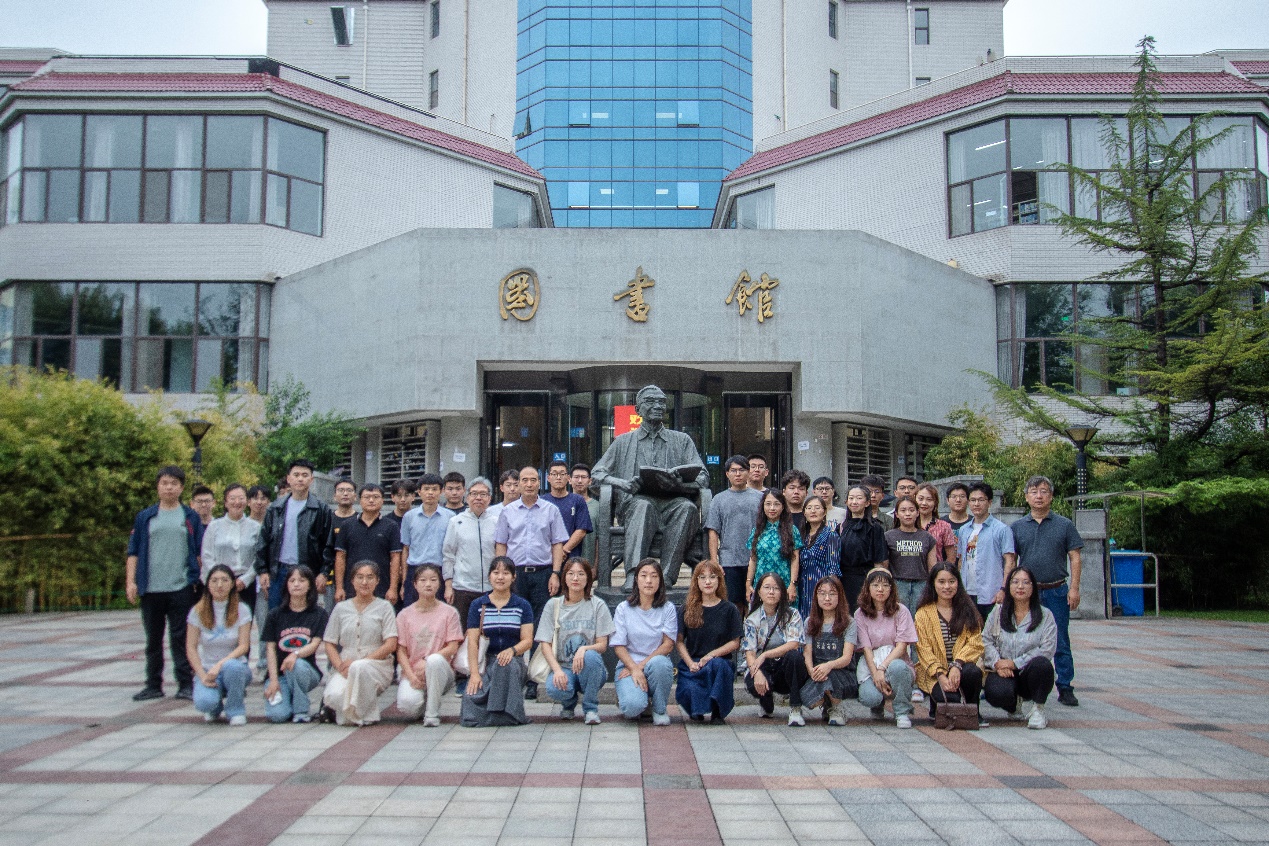
This research group continuously recruits PhD and master’s students and warmly welcomes motivated young scholars from related disciplines—including transportation, logistics management and engineering, e-commerce, big data, and artificial intelligence—to join us!
Ⅱ. Team Member Profiles
The team has been deeply engaged in the fields of smart logistics and industrial data spaces for many years, with a core membership comprising 2 professors, 4 associate professors, 1 senior engineer, 1 lecturer, and more than 40 doctoral and master’s students.

Wang Xifu is a Professor and Doctoral Supervisor in the Department of Logistics Engineering, School of Traffic and Transportation, Beijing Jiaotong University (BJTU). A pioneer and practitioner in the development of China’s smart logistics industry and a renowned logistics expert, he also serves as Chief Advisor to JD Logistics. During his tenure as Director of the Department of Logistics Engineering at BJTU, he led the establishment of the department within the School of Traffic and Transportation and built “Logistics Engineering” into a National First-Class Undergraduate Program. In recent years, he has been frequently interviewed by China Central Television (CCTV) to provide comprehensive analyses on the current state and future trends of China’s logistics sector. He has led or participated in over 100 national and industry-level key projects, published more than 200 high-quality academic papers in transportation and logistics, authored or co-authored 24 monographs and textbooks, holds over 20 software copyrights and more than 10 invention patents, and has received one National Science and Technology Progress Award (Second Class) and over ten provincial- or ministerial-level science and technology awards.

Shen Mengru is an Associate Professor and Doctoral Supervisor, currently serving as Secretary and Deputy Director of the Department of Transportation Information Management Engineering at Beijing Jiaotong University, and was a visiting scholar at Columbia University in the United States. She also serves as Director of the Office of the Key Laboratory of Comprehensive Transportation Big Data Application Technology (Ministry of Transport), Deputy Secretary-General of the Big Data Branch of the China Federation of Logistics & Purchasing (CFLP), Deputy Secretary-General of the Smart Logistics Branch of the China Information Association, and a member of the National Technical Committee on Container Standardization. She has led or participated in more than 50 projects, including National Key R&D Programs, provincial- and ministerial-level science and technology support programs, and industry collaboration initiatives. She has published over 40 high-quality academic papers and authored 6 monographs. Her work in smart logistics has yielded 11 invention patents and 15 software copyrights. She has received the CFLP Science and Technology Progress Award (First Class once, Second Class twice), the China Highway Society Transport and Logistics Innovation Award, and other provincial- or ministerial-level honors, as well as the “Young Talent” award from Beijing Jiaotong University.

Sun Hongsheng is a Senior Engineer at the School of Traffic and Transportation, Beijing Jiaotong University. He has published over 40 academic papers in publicly issued journals and international conferences and has led or participated in 47 projects, including those funded by the Science and Technology Department of the Ministry of Railways and the Innovation and Technology Center of Beijing Jiaotong University. His participation in the project “Key Technologies and Applications of IoT in Modern Logistics” was awarded the CFLP Science and Technology Progress Award (Second Class) in 2012.

Yang Kai is an Associate Professor and Doctoral Supervisor at the School of Traffic and Transportation, Beijing Jiaotong University. He also serves as a Council Member of the Intelligent Computing Branch of the Chinese Operations Research Society and a Committee Member of the Underground Logistics Professional Committee of the Chinese Society for Rock Mechanics & Engineering. He has published over 70 journal and conference papers, authored 1 monograph, holds 3 patents, and has led or participated in 18 projects, including the National Natural Science Foundation of China (Youth Program) and sub-projects under the National Key R&D Program.

Yun Lifei is an Associate Professor and holds a PhD. She currently serves as the Publicity Officer of the Faculty Party Branch in the Department of Logistics Engineering at Beijing Jiaotong University. She has published over 10 academic papers, holds 1 invention patent and 2 monographs, and has led or participated in 11 projects, including the National Natural Science Foundation of China (Youth Fund), projects from National Key Laboratories, and research initiatives from the Innovation and Technology Center of Beijing Jiaotong University.

Sun Xun is an Associate Professor with a PhD, affiliated with the Department of Transportation Information at the School of Traffic and Transportation, Beijing Jiaotong University. His research focuses on transportation systems engineering, travel behavior analysis and demand forecasting, information systems and simulation in transportation, intelligent transportation systems (ITS), and e-commerce. He has published multiple journal papers.

Shen Xisheng is a Lecturer with a PhD at the School of Traffic and Transportation, Beijing Jiaotong University. He has published multiple journal papers and has led or participated in over 60 projects funded by the Ministry of Science and Technology (“Science and Technology Support” Program), the Science and Technology Department of the Ministry of Railways, the Beijing Municipal Science & Technology Commission, and the Innovation and Technology Center of Beijing Jiaotong University.
III. Research Achievements
1. Representative Research Projects
Currently, the team has undertaken more than 100 research projects, primarily covering logistics industry planning, digital platform design, development schemes for bulk commodity supply chain logistics, and implementation plans for multimodal transport, involving multiple fields such as smart logistics, green logistics, agricultural product logistics, port and shipping logistics, and emergency logistics.
(1) Logistics Industry Planning and Supply-Demand Balance Theory
Focusing on regional logistics development, logistics park construction and operation, and enterprise logistics industry development, the team has developed integrated regional logistics solutions, logistics park planning schemes, top-level design schemes for overall enterprise logistics industry development, and logistics-trade development planning schemes. Some representative projects are as follows:
- Special Planning for Building a Modern Logistics System in Xiong’an New Area
- Planning of Daxing Airport (Langfang) Lin Kong International Trade & Logistics Port
- Construction Scheme for Beijing Urban–Rural Large-Scale Warehouse Bases
- Logistics Industry Development Plan for Shandong Energy Group
- Strategic Development Plan for Jining Port & Shipping Group
(2) Smart Logistics Digital Platform Design and Operational Implementation Methodology
Based on the digital transformation needs of industries and enterprises, the demand for supply chain transparency, and the trend toward industrial ecosystem development, the team innovatively applies big data, artificial intelligence, and other technologies to design smart platforms for governments and enterprises. Some representative projects are as follows:
- China-Europe Railway Express Information Integration Platform
- Construction of the Beijing–Hangzhou Grand Canal Smart Logistics Big Data Service Platform
- Construction of the National Northwest (Gansu) Logistics Industry Big Data Center
- R&D and Application Demonstration of an Intelligent Management System for Small- and Medium-Sized Ports
(3) Development Approaches for Bulk Commodity Supply Chain Logistics
Focusing on bulk commodities such as coal, agricultural products, building materials, and steel, the team collaborates with large central state-owned enterprises including China Energy Investment Corporation, China State Railway Group, and China Post to study development approaches for bulk commodity supply chain logistics. Some representative projects are as follows:
- Analysis of the Potential and Countermeasures for Shifting Iron Ore Transport from Road to Rail (Commissioned by the National Railway Administration)
- Construction of a Green Agricultural Product Supply Chain System in Yunnan Province
- Research on the Organizational and Operational Model of China Post’s Agricultural Product Supply Chain
(4) Construction of Trusted Data Spaces in the Logistics Industry
Addressing the development needs of the logistics industry and bottlenecks in data circulation, the team studies implementation pathways for open and interconnected public data, builds demonstration scenarios for open and interconnected logistics data, and promotes standardized development of data systems. Some representative projects are as follows:
- Research on Implementation Pathways for Open and Interconnected Public Logistics Data (Commissioned by the National Data Administration)
- Demonstration Scenario Construction for “Open and Interconnected Logistics Data” (Commissioned by the National Data Administration)
- Construction of a Standardization System for Logistics Data
(5) Implementation Plans and Standardization for Multimodal Transport Development
In line with the Ministry of Transport’s policies on multimodal transport demonstration projects, the team provides governments and enterprises with planning and design of multimodal transport logistics hubs and solutions, offering new methods and ideas to improve logistics efficiency and realize the transformation and upgrading of freight transport modes. Some representative projects are as follows:
- Implementation Plan for Multimodal Transport Development in Zhuzhou City
- Logistics Industry Planning for Longgong Port Multimodal Transport Industrial Park, Jining Port & Shipping Group
- Demonstration Project for Water–Rail–Road Multimodal Transport at the Three Gorges Hub Port in the Yangtze River Economic Belt
- Drafting of the Group Standard “Technical Requirements for Data Exchange under the ‘Single Document’ Customer Service Model in Multimodal Transport”
2. Representative Papers
Over the years, the team has published more than 300 high-quality academic papers in well-known domestic and international journals, including over 100 SCI-indexed papers and more than 60 EI-indexed papers. The research covers areas such as multimodal transport network optimization, emergency logistics system research, robustness of logistics networks, and multi-agent game theory in supply chains. Some representative papers are as follows:
(1)Yun L., Wang X., Fan H., et al. Reliable facility location design with round-trip transportation under imperfect information Part I: A discrete model. Transportation Research Part E, 2020, 133: 101825.
(2)Wei C., Xifu W. Brittleness Evolution Model of the Supply Chain Network Based on Adaptive Agent Graph Theory under the COVID-19 Pandemic. Sustainability, 2022, 14(19): 12211.
(3)Zhongbin Z., Xifu W., Suxin C., et al. A New Synchronous Handling Technology of Double Stake Container Trains in Sea-Rail Intermodal Terminals. Sustainability, 2022, 14(18): 11254.
(4)Wei C., Xifu W. A Multi-objective Multiperiod Mixed-Integer Programming Optimization Model for Integrated Scheduling of Supply Chain Under Demand Uncertainty. IEEE Access, 2022, 10: 63958–63970.
(5)Wei C., Xifu W. A Multiobjective Multiperiod Mixed-Integer Programming Optimization Model for Integrated Scheduling of Supply Chain Under Demand Uncertainty. IEEE Access, 2022, 10: 63958–63970.
(6)J. Ma, X. Wang, Kai Yang, L. Jiang, Y. Gao. Optimizing inland port scale and function decisions: A bilevel programming approach. International Journal of Industrial Engineering Computations, 2023, 14: 483–500.
(7)L. Jiang, X. Wang, Kai Yang, Y. Gao. Bilevel optimization for the reorganization of inland river ports: A niche perspective. Socio-Economic Planning Sciences, 2023, 86: 101466.
(8)J. Gao, Kai Yang, M. Shen, L. Yang. Data-driven traffic sensor location and path flow estimation using Wasserstein metric. Applied Mathematical Modelling, 2024, 133: 211–231.
(9)Zhao Z., Shen M., Chen J., et al. Design and optimization of the collaborative container logistics system between a dry port and a water port. Computers & Industrial Engineering, 2024, 198: 110654.
(10)Yao Y., Shen M., et al. Four-Party Evolutionary Game Analysis of Value Co-Creation Behavior of Bulk Logistics Enterprises in Digital Transformation. Journal of Theoretical and Applied Electronic Commerce Research, 2024, 19(3): 2400.
(11)M. Shen, Z. Zhao, H. Wang, X. Wang, Z. Jiang, Kai Yang, Z. Wang, W. Liu. Round-trip multimodal transportation routes planning for foldable vehicle racks. Maritime Policy & Management, 2024.
3. Awards
The team has cumulatively received more than 20 national and provincial/ministerial-level awards, covering research achievements in smart logistics, logistics industry big data platforms, IoT and modern logistics, railway logistics system optimization, coal logistics technologies, and information systems. Some awards are as follows:
(1) First Prize, Science and Technology Progress Award, China Federation of Logistics & Purchasing (CFLP), 2022
(2) Second Prize, CFLP Science and Technology Progress Award, 2022
(3) Transport and Logistics Innovation Award, China Highway Society, 2021
(4) Second Prize, CFLP Science and Technology Progress Award, 2021
(5) Shandong Provincial Coal Industry Science and Technology Award Committee, 2016
(6) Third Prize, State Administration of Work Safety, 2016
(7) Third Prize, CFLP Science and Technology Progress Award, 2013
(8) Second Prize, CFLP Science and Technology Progress Award, 2013
(9) Second Prize, China Coal Industry Association Science and Technology Award, 2012
(10) Second Prize, CFLP Science and Technology Progress Award, 2012
(11) First Prize, CFLP Science and Technology Progress Award, 2011
(12) Third Prize, State Administration of Work Safety, 2006
4. Intellectual Property
The team has obtained more than 20 invention patents and over 50 software copyrights, mainly concentrated in the fields of smart logistics, logistics big data platforms, information technology, and intelligent transportation systems. Some representative invention patents and software copyrights are as follows.
(1) Representative Invention Patents
- A Smart Logistics Big Data Service Platform for the Petrochemical Industry
- A Management Method, System, Storage Medium, and Terminal for Petrochemical Logistics Parks
- Petrochemical Logistics Warehousing and Tank Farm Management System, Method, Storage Medium, and Terminal
- An Expert System for Predicting and Managing Subsidence Caused by Mining Beneath Dedicated Railway Switch Clusters
- An Intelligent Information Processing System for Bulk Commodity Logistics Transportation Transactions
- A Big Data–Based Intelligent Dispatching System and Method for Inland Waterway Port and Shipping Smart Logistics
- An Intelligent Distribution Management System for Inland Waterway Port and Shipping Logistics
- A Management System for Inland Port-Adjacent Logistics Parks
- A USB–ZigBee Northbound Interface Implementation Method Based on Serial Port Callback Mechanism
- A Wi-Fi–ZigBee Northbound Interface Implementation Method Based on Callback Mechanism
(2) Representative Software Copyrights
- YunLaiLai Warehouse-side iOS App V1.0 – Petrochemical Smart Logistics Big Data Service Platform
- YunLaiLai Cargo-source-side iOS App V1.0 – Petrochemical Smart Logistics Big Data Service Platform
- YunLaiLai Capacity-side iOS App V1.0 – Petrochemical Smart Logistics Big Data Service Platform
- YunLaiLai Web System V1.0 – Petrochemical Smart Logistics Big Data Service Platform
- Big Data Intelligent Analytics System – Petrochemical Smart Logistics Big Data Service Platform
- Security Management System V1.0 – Petrochemical Smart Logistics Big Data Service Platform
- Smart Park Logistics Management System V1.0 – Petrochemical Smart Logistics Big Data Service Platform
5. Publications
The team has published more than 20 monographs and textbooks, covering topics such as smart logistics, intelligent supply chains, blockchain and smart logistics, urban logistics, agricultural product logistics, big data and smart logistics, IoT and artificial intelligence, coal logistics, intelligent railway transportation, and smart ports and waterway logistics. Some publications are as follows:
(1) Smart Logistics and Supply Chain Information Platforms
(2) Blockchain and Smart Logistics
(3) Smart Logistics and Supply Chain Information Platforms
(4) Regional Coal Logistics Management
(5) Urban Green Smart Logistics
(6) Modern Logistics Technologies
(7) Information Technologies in Modern Logistics
(8) Big Data and Smart Logistics
(9) Smart Communities: The Future Home in the Era of the Internet of Things
(10) Internet of Things and Intelligent Logistics
(11) Internet of Things and Modern Logistics
(12) Internet of Things and Logistics Information Systems
(13) Management of Dedicated Railway Transportation
(14) Internet of Things and Supply Chain
(15) Internet of Things and Railway Transportation Management
(16) Introduction to Highway Network Operation Monitoring and Management
IV. Team Contact Person and Contact Information
Contact Person: Mengru Shen
Contact Email: mrshen@bjtu.edu.cn
