1. Team Overview
The Urban Rail Transit Planning and Operations Research Team is dedicated to the development of urban rail transit disciplines. In the realm of theoretical methods and technical systems related to network planning, construction planning, and design phases of urban rail transit systems, the team has proposed methodologies for enhancing the coordination between urban rail transit networks and integrated urban transportation networks, demand forecasting techniques, capacity analysis technologies for lines, depots, and stations, as well as design methods for station track layouts including parking tracks, crossover tracks, and turnaround tracks.
During the operational phase of urban rail transit systems, the team focuses on research regarding train scheduling organization and operation adjustment methods under normal and emergency conditions, such as optimizing train operations during incidents, coordinating passenger flow management between stations and trains under high passenger volume scenarios, and synergizing urban rail transit with ground transportation vehicles. Additionally, the team explores network load balancing technology that considers supply-demand matching, investigates issues related to networked capacity allocation and traffic plan optimization, and studies shared resource management and optimization techniques within the context of vehicle bases, dispatch centers, and safety emergency management resources.
Our research group recruits PhD and master’s students year-round and warmly welcomes motivated young talents from fields such as transportation planning and management, systems engineering, urban transportation engineering, and integrated transportation to join us!
2. Introduction to Team Members
The team consists of 7 members: 4 professors and 3 associate professors.

Mao Baohua, Professor at the School of Traffic and Transportation, doctoral supervisor, established China's first undergraduate program focused on urban rail transit at a 211 Project university. He serves as Executive Director of the China Comprehensive Transportation Research Center at Beijing Jiaotong University, Deputy Director of the Capital Think Tank for Comprehensive Transportation Development, and Vice President of the National Academy of Transportation. His research covers transportation planning and management, intelligent transportation, among others. He has led numerous significant projects and published over 200 papers.
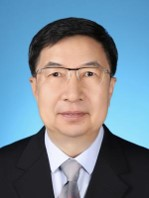
Jia Shunping, Professor, doctoral supervisor, and Executive Deputy Editor-in-Chief of Journal of Transportation Systems Engineering and Information Technology. He focuses on transportation planning and management, transportation economic analysis, and smart transportation. He has authored several books and over 70 papers, participated in or led more than 90 research projects, and received multiple awards. He frequently appears on mainstream media like CCTV to discuss transportation issues.

Bai Yun, Professor and Deputy Dean of the School of Traffic and Transportation, specializes in transportation planning and management, particularly in energy-saving technologies and transport organization optimization for rail transit. He has led multiple national-level projects, published extensively, and developed software and equipment used by over 30 design or operation units, achieving significant economic benefits.

Chen Shaokuan, Professor and Head of the Department of Urban Rail Transit, focuses on key theories and technologies in rail transit planning and operations. He has led over 50 projects, published over 130 academic papers, and contributed to national and local standards. He is also a core contributor to national-level quality courses on urban rail transit planning and design.

Chen Yao, Associate Professor and Deputy Secretary-General of the Transportation Systems Engineering Committee of the Chinese Systems Engineering Society. His work includes optimizing urban rail transit operations management, leading multiple national-level projects, and publishing over 50 journal papers, including in prestigious international journals.

Xu Qi, Associate Professor and Partner of "Street Responsibility Planner" in Haidian District, Beijing, focuses on integrating urban rail transit with land use and optimizing urban rail transit operations. He has undertaken numerous government and corporate consulting projects, published two monographs, and holds two invention patents.

Feng Jia, Associate Professor whose main research areas include urban rail transit operation optimization, system planning methods, and resource sharing theories. She has led various national-level projects and published over 20 papers in domestic and international academic journals and conferences. She serves as a reviewer for several international and domestic journals.
3.Research Achievements (Video: Please click to play)
3.1 Representative Publications
(1) Journal Papers
- Fan Wen, Yao Chen, Yun Bai, Qiaozhen Zhu, Ninghai Li. Urban rail train timetabling for the end-of-service period with passenger accessibility and operation cost: An advanced benders decomposition algorithm. Transportation Research Part B, 2024, 190: 103094.
- Yao Chen, Yang Liu, Yun Bai, Baohua Mao. Real-time dispatch management of shared autonomous vehicles with on-demand and pre-booked requests. Transportation Research Part A, 2024, 81: 104021.
- Youcheng Huang, Zhijian Zhang, Qi Xu, Siwei Dai, Yue Chen. Causality between multi-scale built environment and rail transit ridership in Beijing and Tokyo. Transportation Research Part D, 2024, 130, 104150.
- Yao Chen, Yang Liu. Integrated optimization of planning and operations for shared autonomous electric vehicle systems. Transportation Science,2023,57,106-134.
- Yue Chen, Shunping Jia, Qi Xu, Zhongsheng Xiao, Shujing Zhang. Measuring the dynamic accessibility to COVID-19 testing sites in the 15-min city: A focus on service congestion and mobility difference. Journal of Transport Geography, 2023, 111, 103670.
- Hao Guo, Yao Chen, Yang Liu. Shared autonomous vehicle management considering competition with human-driven private vehicles. Transportation Research Part C, 2022,36:103547.
- Qian Wang, Yun Bai, Yao Chen, Qian Fu, Paul Schonfeld. Optimization of metro vertical alignment for minimized construction costs and traction energy: A dynamic programming approach. Tunnelling and Underground Space Technology, 2022, 104722.
- Gehui Liu, Shaokuan Chen, Tin Kin Ho, Xinchen Ran, Baohua Mao, Zhen Lan. Optimum opportunistic maintenance schedule over variable horizons considering multi-stage degradation and dynamic strategy. Reliability Engineering and System Safety, 2022, 225: 108572.
- Yun Bai, Qianyun Hu, Haiyang Guo, Tin Kin Ho, Baohua Mao. Timetable optimization for metro lines connecting to intercity railway stations to minimize passenger waiting time. IEEE Transactions on Intelligent Transportation Systems, 2021, 22 (1): 79-90.
- Zhujun Li, Amer Shalaby, Matthew Roorda, Baohua Mao. Urban rail service design for collaborative passenger and freight transport. Transportation Research Part E, 2021, 147, 102205.
- Yao Chen, Kun An. Integrated optimization of bus bridging routes and timetables for rail disruptions. European Journal of Operational Research, 2021, 295(2): 484-498.
- Gehui Liu, Shaokuan Chen, Hua Jin, Shuang Liu. Optimum opportunistic maintenance schedule incorporating delay time theory with imperfect maintenance [J]. Reliability Engineering and System Safety, 2021, 213: 107668.
- Yun Bai, Yunwen Cao, Zhao Yu, Tin Kin Ho, Clive Roberts, Baohua Mao. Cooperative control of metro trains to minimize net energy consumption. IEEE Transactions on Intelligent Transportation Systems, 2020, 21(5): 2063-2074.
- Yao Chen, Baohua Mao, Yun Bai, Tin Kin Ho, Zhujun Li. Timetable synchronization of last trains for urban rail networks with maximum accessibility. Transportation Research Part C, 2019, 99: 110-129.
- Yuting Zhu, Baohua Mao, Yun Bai, Shaokuan Chen. A bi-level model for single-line rail timetable design with consideration of demand and capacity. Transportation Research Part C, 2017, 85, 211-233.
- Yun Bai, Tin Kin Ho, Baohua Mao, Yong Ding, Shaokuang Chen. Energy-efficient locomotive operation for Chinese mainline railways by fuzzy predictive control. IEEE Transactions on Intelligent Transportation Systems, 2014, 14 (3): 938-948.
- Shaokuan Chen, Tin Kin Ho, Baohua Mao, Yun Bai. A bi-objective maintenance scheduling for power feeding substations in electrified railways. Transportation Research Part C: Emerging Technologies, 2014, 44: 350-362.
- Shaokuan Chen, Yan Leng, Baohua Mao, Shuang Liu. Integrated weight-based multi-criteria evaluation on transfer in large transport terminals: A case study of the Beijing South Railway Station. Transportation Research Part A: Policy and Practice, 2014, 66 (08): 13-26.
- Shaokuan Chen, Baohua Mao, Shuang Liu, Quanxin Sun, Wei Wei, Linxia Zhan. Computer-aided analysis and evaluation on ramp spacing along urban expressways . Transportation Research Part C, 2013, 36 (11): 381-393.
- Chen Yao, Bai Yun, Mao Baohua, Wen Fang. Optimization Method for Train Route Plan under Cross-Line Conditions [J]. Journal of the China Railway Society, 2024, 46(08): 21-29.
- Zhang Shujing, Jia Shunping, Peng Peng, Mao Baohua. Analysis of Parking Management Game Between Government and Shared Bike Enterprises Based on Quantum Response Equilibrium [J]. Control and Decision, 2024, 39(02): 641-648.
- Jinhua, Chen Shaokuan, Feng Xujie, Bai Yun, Li Hao. Optimization Method for Subway Crew Rostering Considering Crew Duty Requirements [J]. Journal of the China Railway Society, 2023, 45(07): 29-37.
- Zhang Xiaoyu, Song Liying, Deng Jin, Xu Qi. Study on Classification of Urban Rail Transit Lines and Factors Influencing Passenger Volume from the Perspective of Land Use [J]. Progress in Geography, 2023, 42(12): 2337-2349.
- Li Zongran, Bai Yun, Chen Yao, Ming Xianjun, Cao Yunwen. Optimization of Unpaired Operation Diagrams for Metro Trains Under Tidal Passenger Flow [J]. China Railway Science, 2022, 43(6): 207-218.
- Mao Baohua, Lu Xia, Huang Junsheng, He Tianjian, Chen Haibo. Development Pathways of Hydrogen Energy in China's Transport Sector Toward Carbon Neutrality [J]. Journal of Transportation Systems Engineering and Information Technology, 2021, 21(06): 234-243.
- Wang Qingyun, Mao Baohua, Zhang Guowu. Evolution of Systems Engineering in China’s Transportation System [J]. Journal of Transportation Systems Engineering and Information Technology, 2021, 21(05): 2-11.
- Xu Dejie, Mao Baohua, Chen Shaokuan, Gong Liang, Zeng Junwei. Optimization of Train Operation Schemes Considering Proportions of Large and Small Routes [J]. Journal of Traffic and Transportation Engineering, 2021, 21(02): 173-186.
- Peng Shiyao, Chen Shaokuan, Xu Qi, Niu Jiagi. Spatial Characteristics of Land Use and Rail Transit Passenger Flow Based on POI [J]. Acta Geographica Sinica, 2021, 76(02): 459-470.
- Bai Yun, Bai Xiao, Sun Yuanguang, Li Jiajie, Zhou Yuhe. Energy-Saving Design Optimization Model for Longitudinal Profiles of Subway Line Segments [J]. Journal of the China Railway Society, 2020, 42(9): 10-16.
- Tong Shuo, Chen Shaokuan, Liu Gehui, Liu Shuang, Mao Baohua. Optimization Model for EMU Operation Plan Considering Continuation Reliability [J]. Journal of the China Railway Society, 2020, 42(04): 27-34.
- Ran Xinchen, Chen Shaokuan, Chen Lei, Jia Wenzheng. Optimization Method for Metro Train Energy-Saving Timetable Considering Spatial Distribution of Passenger Flow [J]. Journal of Transportation Systems Engineering and Information Technology, 2020, 20(03): 103-110.
- Zhang Tong, Mao Baohua, Xu Qi, Feng Jia, Tang Jimeng. Optimization of Tram Timetables Considering Energy-Saving Targets [J]. Journal of Traffic and Transportation Engineering, 2019, 19(06): 171-181.
- Ma Cunrui, Mao Baohua, Bai Yun, Du Shanxu, Zhang Sijia. Energy-Saving Control Method for High-Speed Trains Considering Overhead Wire Phase Separation [J]. China Railway Science, 2019, 40(04): 137-144.
- Li Zhujun, Mao Baohua, Su Mei, Bai Yun, Chen Yao. Optimization Design of ATP Safety Braking Curve for High-Speed Railways [J]. Journal of the China Railway Society, 2018, 40(04): 18-23.
- Chen Shaokuan, Di Yue, Shi Rongdan, Li Jing, Wang Bo. Analysis of Fire Impact and Evacuation at Metro Stations [J]. Journal of Transportation Systems Engineering and Information Technology, 2017, 17(01): 241-248.
- Liu Lu, Mao Baohua, Liang Xiao, Zhu Yuting, Zhao Xinmiao. Study on Capacity of Bay-Type Bus Stops Considering Total Travel Time [J]. China Journal of Highway and Transport, 2016, 29(01): 115-119, 142.
- Zhou Yangfan, Jia Shunping, Chen Shaokuan, Wei Wei. Optimization Model for Signal Priority Duration Threshold of Trams [J]. Journal of Traffic and Transportation Engineering, 2016, 16(05): 151-158.
- Bai Yun, Chen Yao, Chen Yue, Cao Yunwen. Research on Adjustment Methods for Metro Train Operations Considering Total Delays and Balanced Departure and Arrival Times [J]. Journal of Transportation Systems Engineering and Information Technology, 2014, 14(3): 104-110.
- Chen Shaokuan, Wang Xiudan, Bai Yun, Liu Haidong, Mao Baohua. Optimization Model for Maintenance Plans of Railway Traction Overhead Contact Networks Based on Minimum Costs [J]. Journal of the China Railway Society, 2013, 35(12): 37-42.
- Chen Shaokuan, Wei Wei, Mao Baohua, Guan Wei. Feature Analysis of Road Traffic Status Based on Improved Spatiotemporal Moran’s I Index [J]. Acta Physica Sinica, 2013, 62(14): 527-533.
(2) Monographs
- Baohua Mao, Qi Xu. Routledge Handbook of Transport in Asia [M]. London: Routledge, 2018, pp 94–122.
- Baohua Mao. The Belt and Road Initiative and Transportation [M]. Beijing: China Communications Press, 2018.
- Baohua Mao, Mingjun Liu, Rong Huang, Peng Du, et al. Theory and Key Technologies of Networked Rail Transit Operations Management [M]. Beijing: Science Press, 2011.
- Baohua Mao, Shaokuan Chen, Yun Bai, et al. Urban Rail Transit Planning and Design (3rd Edition) [M]. Beijing: China Communications Press, 2020.
- Baohua Mao, Xiamiao Li, Huimin Niu, et al. Operation Management of Urban Rail Transit Systems (2nd Edition) [M]. Beijing: China Communications Press, 2017.
- Baohua Mao, Xiamiao Li, Haidong Liu, Yong Ding, et al. Train Operation Calculation and Design (2nd Edition) [M]. Beijing: China Communications Press, 2013.
- Baohua Mao, Ziyou Gao, Yun Bai, et al. Theory and Methods of Urban Rail Transit Network Operations Management [M]. Beijing: China Communications Press, 2018.
- Baohua Mao, Yun Bai, Shaokuan Chen, Xiao Liang, et al. Energy-Saving and Emission-Reduction Technologies and Policies for Integrated Transportation Systems [M]. Beijing: Beijing Jiaotong University Press, 2016.
- Baohua Mao, Jifu Guo, Jinchuan Chen, Shuang Liu. Empirical Study on the Evolution of Urban Integrated Transport Structure [M]. Beijing: China Communications Press, 2011.
- Baohua Mao, Mingsheng Wang, Huimin Niu, Shunping Jia, et al. Urban Passenger Transport Management [M]. Beijing: China Communications Press, 2009.
- Baohua Mao, Bingfeng Si, Zhili Liu. Theory and Methods of Urban Rail Transit Network Management and Revenue Allocation [M]. Beijing: Science Press, 2007.
- Baohua Mao, Zhuangzhi Sun, Shunping Jia, et al. Methods and Practical Studies on Regional Traffic Organization Optimization [M]. Beijing: China Communications Press, 2007.
- Baohua Mao, Fan Jiang, Qian Liu, et al. Urban Rail Transit [M]. Beijing: Science Press, 2001.
- Shunping Jia. Transportation Economics (4th Edition) [M]. Beijing: China Communications Press, 2024.
- Peng He, Baohua Mao, Yan Li, Qi Xu. Research on Interaction Strategies between Metropolitan Area Transportation and Land Use [M]. Beijing: China Railway Publishing House, 2023.
- Yuanzhou Yang, Yun Bai, Xujie Feng, Yang Wang, Qianyun Hu, et al. Renovation and Practice of Urban Rail Transit Infrastructure and Equipment [M]. Beijing: China Communications Press, 2022.
- Peng He, Qi Xu, He Liu, Yan Li, Yoshihisa Sawano, Katsunori Sakon. Renovation of Existing Railway Lines and Urban Regeneration in Japanese Metropolitan Areas [M]. Beijing: China Communications Press, 2025.
3.2 Representative Research Projects
|
Project Title
|
Project Source
|
Project Time
|
|
Energy-Efficient Technology & Policies of Rail Transit Operations in China
|
International Collaboration
|
2010-2011
|
|
Evaluation of rail transit technical specifications and their development plans
|
International Collaboration
|
2009-2010
|
|
Research on energy consumption and emission factors and their comparability of different modes of transportation
|
International Collaboration
|
2009
|
|
Research on the operation efficiency and structural optimization of urban integrated transportation system
|
Ministry of Science and Technology “973” Project
|
2012-2016
|
|
A comprehensive empirical study on the traffic congestion problem of typical large cities
|
Ministry of Science and Technology “973” Project
|
2008-2011
|
|
Induce the generation of strategies and optimize the system of technology under special needs
|
Ministry of Science and Technology “863” Project
|
2011-2013
|
|
Intelligent induction control technology for regional transportation networking
|
Ministry of Science and Technology “863” Project
|
2011-2013
|
|
Analysis of railway transportation market competitiveness
|
Energy Foundation
|
2023-2024
|
|
Research on the strategy of optimizing the travel structure of high-speed railway and civil aviation under the dual carbon goal
|
Energy Foundation
|
2022-2023
|
|
Research on issues related to the strategy of railway power
|
National Development and Reform Commission
|
2018-2020
|
|
Research on technical requirements and standards for green operation of urban rail transit
|
Ministry of Transportation
|
2023-2024
|
|
Research on information application related technologies - deepening research on the overall technical scheme of railway customer service center
|
China Railway Corporation (Former Ministry of Railways)
|
2009-2010
|
|
"Research on Modern Logistics Management for Coordinated Economic, Social and Environmental Development": Multimodal Logistics Operation and Management
|
Major projects of the National Natural Science Foundation of China
|
2014-2018
|
|
Research on the design and operation optimization of integrated transportation system in urban agglomerations
|
National Natural Science Foundation “Major” Project
|
2019-2023
|
|
Health Management of Predictive and State-Based Complex Engineering Systems - 2
|
National Natural Science Foundation of China "Focus"
|
2013-2017
|
|
Operation management and modeling methods of regional integrated transportation system
|
National Natural Science Foundation of China "Focus"
|
2012-2016
|
|
Research on the basic theory and key technologies of train operation control and organization
|
National Natural Science Foundation of China "Focus"
|
2007
|
|
Research on the design and optimization method of urban rail transit freight service network under passenger and freight co-transportation
|
National Natural Science Foundation of China
|
2025-2028
|
|
Research on public transportation operation subsidy methods in urban agglomeration areas
|
National Natural Science Foundation of China
|
2020-2023
|
|
Research on the optimization of transportation organization and control of subway trains under the characteristics of tidal passenger flow
|
National Natural Science Foundation of China
|
2020-2023
|
|
Research on the collaborative optimization of comprehensive maintenance plan of rail transit system infrastructure
|
National Natural Science Foundation of China
|
2016-2019
|
|
Research on the theory and method of optimizing the operation plan of train groups based on energy saving
|
National Natural Science Foundation of China
|
2010-2012
|
|
The role and effect of pedestrians and non-motor vehicles on motor vehicle driving behavior in our country's urban road environment
|
National Natural Science Foundation of China
|
2006
|
|
Study on the Development of Green Urban Transport System and Its Application
|
National Natural Science Foundation “Innovation Team” Project
|
2017-2022
|
|
Construction of China’s Modern High-speed Rail Intelligent Transport System
|
China Railway Corporation
|
2023-2024
|
|
Research on Yellow Rail Line and Power Supply Capacity Assessment
|
National Railway Development Corporation
|
2024-2026
|
|
"Railway Passenger Safety Design and Research on Technical Skills"
|
China Railway Group Limited, Major Project
|
2018-2019
|
|
Research on High-Speed Rail Operations and Safety Management Technology – Construction of High-Speed Rail Systems
|
Railway Department Science and Technology
|
2011-2012
|
|
Coastal City Road and Port Environmental Optimization Research
|
Beijing Planning and Natural Resources Commission
|
2023-2024
|
|
Research on the Optimization and Enhancement of the Slow-traffic Travel Environment in Haidian Subdistrict
|
Beijing Planning and Natural Resources Commission
|
2022-2023
|
|
Research on POI Information in Urban Transit Based on Big Data
|
Beijing Urban Transportation Research Institute
|
2020-2021
|
|
Research on the Integration of "High-Speed Rail +" Multimodal Transport and Express Delivery Networks
|
Henan Railway Investment and Construction Co.
|
2024-2025
|
|
Research and Application of Key Technologies for Transport Organization under Energy Conservation and Low Carbon
|
Guangzhou Railway Design Institute Co. Ltd.
|
2023-2024
|
|
Research on Metro Transportation Standards and Specifications Benchmarking International Advanced Levels — Analysis of Development Models and Operational Performance of Metro Systems in Major Cities
|
Beijing Urban Construction Design and Development Group Co., Ltd. Project
|
2020-2021
|
|
Beijing Urban Underground Transport and Land Use Development Research
|
Beijing Jing-Gang Metro Co., Ltd.
|
2020-2021
|
|
Xinjiang Integrated Transportation System Development Plan
|
Beijing Jiaotong University Innovation and Technology Center
|
2010
|
|
Research on Technologies and Solutions for Improving Transfer Efficiency in Shenyang Metro Network Based on Passenger Flow Spatiotemporal Distribution Characteristics
|
Shenyang Metro Group Co., Ltd.
|
2024-2025
|
|
Research on Resource Sharing Methods for Vehicle Depots and Parking Stations in Beijing Metro Network
|
Beijing Subway Operations Co. Ltd.
|
2022-2023
|
|
Zhengzhou Metro 2020-2021 Line Network Large Passenger Flow Simulation System Development Project
|
Zhengzhou Railway Group Co. Ltd.
|
2020-2022
|
|
Railway Infrastructure and City Connection Design Study in Japan
|
Beijing City Development Group
|
2023-2025
|
3.3 Think Tank–Related Achievements
|
name
|
The research report is submitted to the unit
|
Time
|
|
Carbon emission reduction strategies and suggestions for our country's cargo transportation
|
Traffic research suggestions
|
2024
|
|
Research on countermeasures to accelerate the improvement of our country's national transportation convenience level
|
National high-end think tank
|
2023
|
|
Promote the research and development and application of hydrogen energy to build a green transportation power system
|
Decision-making reference of the Ministry of Transport (adopted by internal reference at the provincial and ministerial levels and above)
|
2022
|
|
Do a good job in the comprehensive development of stations and promote the high-quality development of urban rail transit
|
Jiaotong University Think Tank Suggestions (Leadership Instructions)
|
2021
|
|
Research on the construction of comprehensive transportation system in Beijing urban sub-center
|
Decision-making consultation of high-end think tanks in the capital (leader's instructions)
|
2021
|
|
Research on the traffic conversion environment of Beijing South Railway Station, Beijing West Railway Station and Beijing Railway Station and the transportation construction scheme of Fengtai Railway Station (2)-2
|
High-end think tank in the capital
|
2021
|
|
Focusing on the construction of the "Belt and Road", strengthen foreign cooperation and exchanges in various fields of the transportation system, and gather a strong joint force of "going global"
|
Policy Research Office of the Ministry of Transport (Leader's Instructions)
|
2020
|
|
Focusing on the research on the reform ideas of Beijing's ground bus in 2020 and 2035
|
Decision-making inquiry by the capital's high-end think tank
|
2020
|
3.4 Representative Awards and Honors
|
type
|
Achievement Name
|
Award Name
|
Reward level
|
Award time
|
|
Teaching related
|
Baosteel Outstanding Teacher Award
|
National
|
2011
|
|
Mao was promoted to the Railway Science and Technology Award
|
The 8th Mao Yisheng Railway Science and Technology Award
|
National
|
2006
|
|
Research and practice of wide-caliber and high-quality talent training mode in transportation majors
|
The second prize of national excellent teaching achievements
|
National
|
2005
|
|
"High-level doctoral training model with transportation characteristics"
|
The 8th Beijing Higher Education Teaching Achievement Award
|
provincial and ministerial level
|
2011
|
|
Urban rail transit operation management
|
The first prize of the teaching case of "Ideological and Political Transportation Courses under the Strategy of Transportation Power" of the China Transportation Education Research Association
|
|
2021
|
|
Scientific research related
|
Spatiotemporal distribution law and numerical calculation of urban traffic flow based on behavior
|
Second Prize of National Natural Science Award
|
National
|
2011
|
|
R&D and application of multi-dimensional integrated evaluation system and key technologies of urban rail transit
|
Second prize of Beijing Science and Technology Progress Award
|
provincial and ministerial level
|
2022
|
|
Research on the formation mechanism and relief methods of urban traffic congestion
|
Second Prize of Beijing Science and Technology Award
|
provincial and ministerial level
|
2007
|
|
Research and design of urban rail transit operation and management regulation system in our country
|
2022 Achievements of the Ministry of Transport's Major Scientific and Technological Innovation Achievements Database (Major Scientific and Technological Innovation Projects)
|
provincial and ministerial level
|
2022
|
|
Comprehensive optimization of connecting bus routes and timetables under the failure of urban rail transit
|
2022 Achievements of the Ministry of Transport's Major Scientific and Technological Innovation Achievements Database (Transportation Science and Technology Papers)
|
provincial and ministerial level
|
2022
|
|
Evaluation and application of passenger operating conditions of new urban rail transit lines
|
2019 Achievements of the Ministry of Transport Major Scientific and Technological Innovation Achievements Database (Major Scientific and Technological Innovation Projects)
|
provincial and ministerial level
|
2019
|
|
Key technologies and applications of quantitative evaluation and decision support for urban rail transit
|
First prize of Science and Technology Progress Award of China Urban Rail Transit Association
|
|
2023
|
|
Research on multi-dimensional integration theory and key technologies of urban rail transit planning
|
First prize of Science and Technology Progress Award of China Urban Rail Transit Association
|
|
2022
|
|
Research and application of key technologies for urban rail transit planning, design and operation energy-saving operation
|
Second Prize of Science and Technology Award of China Communications and Transportation Association
|
|
2022
|
|
Research and design of urban rail transit operation and management regulation system in our country
|
First Prize of Science and Technology of China Highway Society
|
|
2020
|
|
Research and application of key technologies of road passenger transport information service system for smart travel
|
Second prize of Science and Technology Award of China Intelligent Transportation Association
|
|
2018
|
|
Research and application of evaluation and application of passenger operating conditions of new urban rail transit lines
|
First Prize of Science and Technology of China Highway Society
|
|
2015
|
|
Research on technical and economic characteristics of integrated transportation system: land use and energy consumption
|
The third prize of the Science and Technology Award of the China Highway Society
|
|
2013
|
|
Rail transit passenger flow prediction method and application
|
Third Prize of Science and Technology of China Intelligent Transportation Association
|
|
2013
|
|
Research and application of the operation mode and transportation organization of the Qinghai-Tibet Railway
|
Second Prize of Science and Technology of China Railway Society
|
|
2007
|
3.5 Representative Intellectual Property
|
type
|
Achievement Name
|
Grade number
|
Time
|
|
patent
|
A type of public transportation data generationMethod and system of generating data in GTFS format
|
ZL202310485904.7
|
2023
|
|
A two-step Bayesian estimation method for building-scale population fused with location data
|
ZL202211262928.8
|
2022
|
|
An optimization method and system for urban rail transit train operation adjustment scheme
|
ZL202111472772.1
|
2021
|
|
One is based on improvementMethod of subway station operation time division method of K-means clustering algorithm
|
ZL201910952490.8
|
2019
|
|
An energy-saving travel method for trams
|
ZL201810092572.5
|
2018
|
|
Energy-saving operation method of trains
|
ZL201810554213.7.
|
2018
|
|
A behavioral perception system and method
|
ZL201710186263. X
|
2017
|
|
A simulation method and system for emergency evacuation of personnel in subway stations
|
ZL201710385386.6
|
2017
|
|
Spatio-temporal analysis methods and systems of urban road traffic conditions
|
ZL201210465041.9
|
2012
|
|
Methods and guidance devices for optimal operation of diesel traction locomotives,
|
ZL200810056557.1.
|
2008
|
|
Software copyright
|
Urban rail transit train operation chart energy-saving optimization system
|
2024SR1431545
|
2024
|
|
Urban rail transit operation map adjustment and paving softwareV1.0
|
2022SRBJ0010
|
2022
|
|
Simulation system for large passenger flow of urban rail transit line network V1.0
|
2021SR1997073
|
2021
|
|
Metro last train timetable coordination and optimization and information query system
|
2020SRBJ0219
|
2020
|
|
Decision assistance system related to urban rail transit train fault rescue
|
2020SR0885488
|
2020
|
|
Urban rail transit energy consumption prediction system
|
2016SR050025
|
2016
|
3.6 Representative Research Achievements
(1) Low-Carbon Transition Pathways in China’s Non-Road Transport Sector under the Dual Carbon Goals
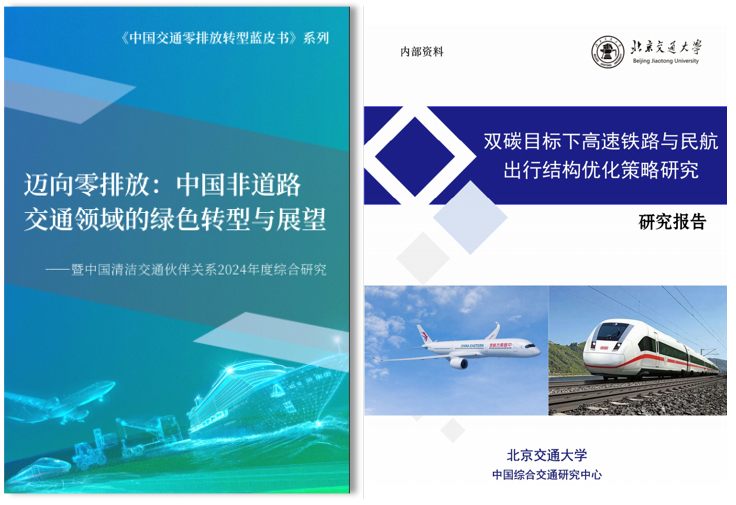
The report Toward Zero Emissions: Green Transformation and Outlook for China’s Non-Road Transport Sector focuses on passenger transport structure adjustment, examining the current status, development trends, and future prospects of high-speed rail (HSR) and civil aviation in China. Under the national “Dual Carbon” (carbon peak and carbon neutrality) strategy, it is critically important to strategically leverage HSR and civil aviation—two high-service-quality modes for medium- and long-distance travel—to achieve rational division of labor between them within medium-distance travel markets. By analyzing the market characteristics and emission profiles of China’s HSR and civil aviation passenger sectors, the study addresses key questions regarding passenger transport restructuring and pollution/carbon reduction, offering practical policy recommendations that provide strong support for achieving the Dual Carbon goals. The related study Optimization Strategies for Passenger Modal Split between High-Speed Rail and Civil Aviation under the Dual Carbon Goals reviews the supply-demand dynamics of China’s HSR and civil aviation passenger markets, analyzes current passenger volumes, and forecasts future trends. It further quantifies carbon reduction outcomes under various market share scenarios between HSR and aviation and proposes targeted policy measures. This work contributes positively to optimizing China’s passenger transport structure, improving HSR utilization, and advancing carbon mitigation in the transportation sector.
(2) Integrated Modeling Method for Urban Rail Transit Ridership and Land Use
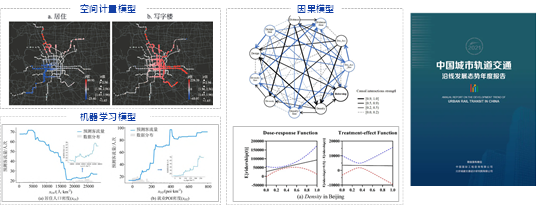
Leveraging multi-source spatiotemporal big data, the team established a multi-level, multi-dimensional characterization system of the built environment around urban rail transit stations based on the “5D” principles of Transit-Oriented Development (TOD). By integrating spatial econometric models (e.g., GWR), machine learning models (e.g., XGBoost), and causal discovery models (e.g., Bayesian networks), the research reveals both linear and nonlinear mechanisms through which the built environment influences station-, line-, and network-level ridership, while also capturing their spatiotemporal heterogeneity. A novel origin-destination (OD) estimation method for metro inter-station flows was proposed, driven jointly by big data and interpretable machine learning. Applied in Beijing, this method achieved prediction errors of only ~6% for daily total entry/exit volumes and ~3% during morning peak hours. These findings have been published in top-tier journals including Transportation Research Part D, Journal of Rail Transport Planning & Management, Journal of Transportation Systems Engineering and Information Technology, and Acta Geographica Sinica, and have informed industry reports such as the Annual Report on Development Trends Along China’s Urban Rail Transit Corridors – 2021, providing valuable decision support for future planning and construction of urban rail systems.
(3) Modeling and Evaluation Methods for Urban Accessibility
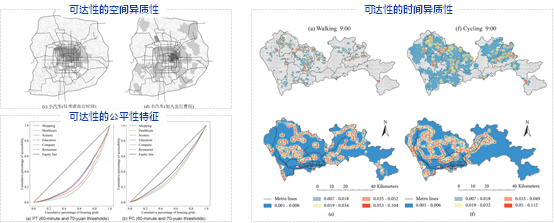
In the context of integrated transport–land use development, the team developed a fine-grained urban accessibility modeling framework. Using heterogeneous big data—including POI, OpenStreetMap (OSM), building footprint, and route-planning data—the research examines the spatiotemporal characteristics of accessibility under both public and private transport modes, and investigates the heterogeneous impacts of travel time uncertainty and travel cost on accessibility. Specifically for urban rail systems, a method was proposed to identify secondary catchment areas of metro stations. A two-step floating catchment area (2SFCA) model incorporating last-mile travel behavior was developed, combined with Lorenz curves and Gini coefficients to analyze employment accessibility and equity across the metro network. These results have been published in leading journals such as Journal of Transport Geography, Journal of Transportation Systems Engineering and Information Technology, and Journal of Zhejiang University (Engineering Science), significantly advancing theoretical and methodological foundations of urban accessibility and supporting evidence-based urban and transport resource allocation.
(4) Energy-Efficient Train Operation Control: Theory and Methods
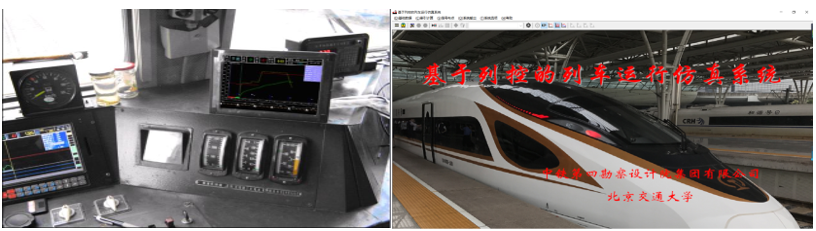
At the single-train level, accounting for dynamic operating environments and time-varying traction/braking resistance parameters, the team developed an energy-efficient train control optimization technique based on fuzzy predictive control and intelligent search algorithms. This system dynamically generates energy-saving driving strategies for the next 3 km ahead, overcoming limitations of conventional methods that struggle to adapt to real-time changes in signals and other operational parameters. The resulting Energy-Efficient Train Driving Advisory Device was deployed for two years at Hefei Locomotive Depot, China Railway Shanghai Group, achieving a 6% energy saving. The device was evaluated by Shanghai Railway Bureau as “nationally leading.” At the multi-train coordination level, considering inter-train coupling effects and regenerative energy reuse patterns, the team formulated a multi-train cooperative energy-saving control model and a joint optimization model for timetables and driving strategies. This approach overcomes the inefficiencies of single-train optimization in utilizing regenerative braking energy and the vulnerability of offline timetable optimization to external disturbances. Additionally, the Train Traction Calculation and Operation Simulation System Based on Train Control was developed, enabling analysis of running times, headways, electric phase separation placement, and signal layout under given track and train control conditions.
(5) Line Design and Capacity Calculation Methods Based on Train Operation Control
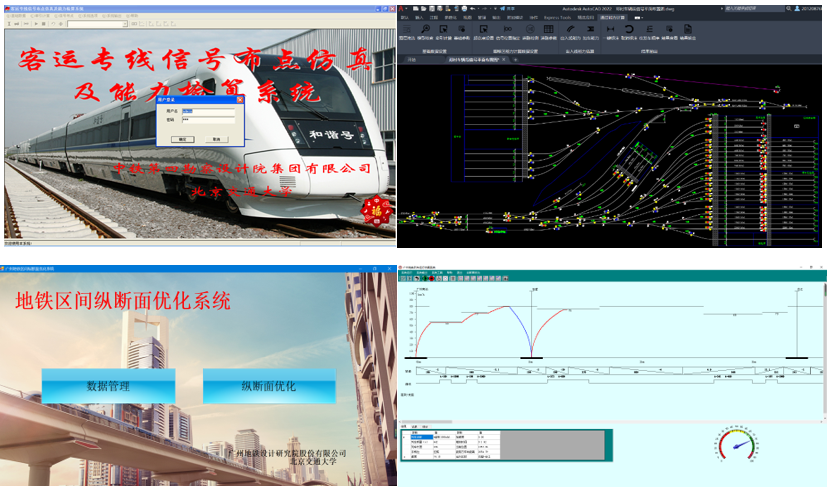
For line section capacity, the team proposed a method to evaluate line capacity and verify operational safety based on signal placement schemes, analyzing the trade-offs between signaling layout, construction costs, and headway. A recursive signal placement method based on maximum track circuit length was introduced, and the High-Speed Railway Section Signal Placement System was developed to assess capacity and safety of signaling layouts.
The Urban Rail Transit Traction Calculation and Automatic Energy-Efficient Gradient Design System was also created to optimize vertical alignment and electric phase separation locations, and has been applied by Guangzhou Metro Design & Research Institute.
For station and depot capacity, the team developed optimization methods for maximizing arrival/departure capacity at railway stations, established capacity calculation models for intermediate turnaround stations in urban rail systems, and studied operation organization optimization via headway compression. Furthermore, a CAD-based software tool—Throat Area Design and Analysis Software for Vehicle Depots Considering Arrival/Departure Capacity and Cost—was developed using .NET framework, enabling automatic capacity calculation for conventional depots, double-deck depots, and depots with turnback access to mainlines.
(6) Timetable and Real-Time Adjustment Technologies Based on Network-Wide Passenger Flow Characteristics
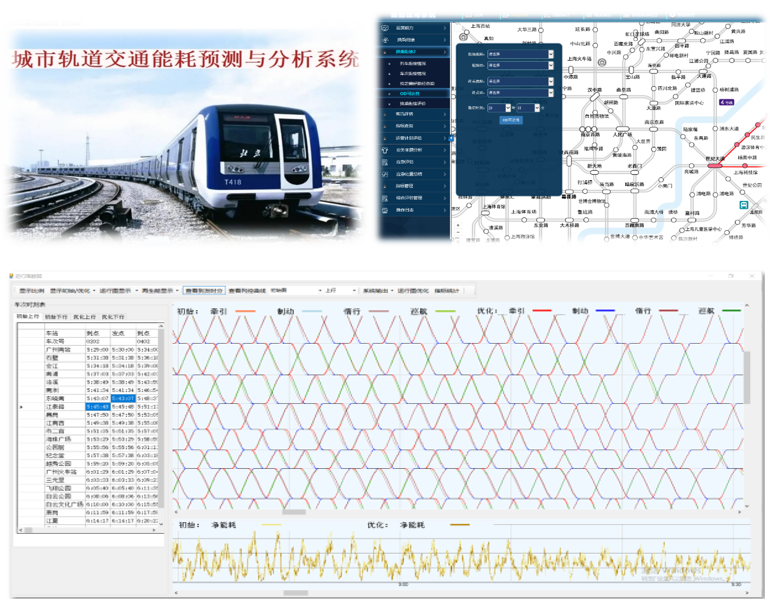
A passenger flow redistribution model was established to analyze how new line openings reshape network-wide ridership patterns and affect operations. The Urban Rail Train Traction Energy Consumption Prediction and Analysis System was developed and applied to support feasibility studies for Beijing Subway’s 2014 new line openings. Regarding timetable planning, the team investigated train service design, scheduling, and rolling stock circulation under diverse operational modes—including cross-line operation, mixed train formations, virtual coupling, multiple routings, express/local services, unbalanced transport, passenger-freight mixed operation, and end-of-service connections. The Energy-Efficient Urban Rail Timetable Optimization System enables adaptive adjustment of train arrival/departure times with energy savings as the primary objective. In real-time dispatching, the team developed methods for train rescheduling that balance total delay and arrival/departure regularity, techniques for handling rescue scenarios, and optimization approaches for cross-line operations and capacity degradation events. Core modules of the Shanghai Rail Transit C3 Network Dispatching Command Center Platform—including capacity assessment under disruption and transfer coordination optimization—were developed to support real-time network/line/station capacity evaluation, large-crowd forecasting, transfer organization, and emergency response planning.
(7) Train Rescheduling System for Emergency Situations
To address the urgent need for rapid response to disruptions in urban rail operations, the team developed a fast solution generation method that meets dispatcher requirements. An optimization-based mathematical model was constructed, accompanied by efficient algorithms that deliver high-quality rescheduling solutions within seconds.Based on this, an Emergency Train Rescheduling Decision Support System was developed to assist dispatchers in command centers with rapid, effective responses to unexpected incidents.
(8) AFC-Based Urban Rail Network Passenger Flow Estimation System
Using Automatic Fare Collection (AFC) tap-in/tap-out data and train schedule information, the team developed passenger path estimation and passenger–train matching algorithms to infer detailed network-wide passenger flows. This system supports applications such as bottleneck identification, precise transfer flow estimation, spatiotemporal passenger journey profiling, train load factor analysis, and post-disruption passenger flow evolution modeling.
(9) Auxiliary Decision System for Rescue-Oriented Track Layout Design
From an operational management perspective, the team studied how track layout configurations affect rescue efficiency when trains lose power due to failures. An optimization model for track layout design incorporating rescue scenarios was formulated, and an auxiliary decision support system was developed to rapidly generate optimal layout configurations under various failure locations and rescue strategies. This system provides a technical foundation for enhancing the operational resilience and practicality of urban rail line designs.
4. Team Contact Information
Contact Person: Chen Yao
Email: chenyao1@bjtu.edu.cn
