1. Team Overview
The research team maintains close alignment with national transportation strategies and on-site railway operational needs, focusing on the optimization of integrated transportation organization and on research related to railway transport capacity and hub planning. The team conducts in-depth investigations into key areas including process control and optimization in transportation systems, demand analysis, resource and infrastructure allocation, network optimization, railway operation planning, capacity calculation and utilization, capacity reserve strategies, and future capacity development.Through extensive collaborations with leading universities and prominent enterprises, the team has established a systematic, full-cycle research methodology that bridges theory, application, engineering implementation, and industrial deployment. Notable theoretical innovations include the formulation of a high-speed railway capacity framework, a top-down design for railway dispatching and operational organization aligned with high-quality development goals, and strategies for optimal capacity matching between high-speed and conventional rail networks along the Beijing–Shanghai corridor.The team has also made significant technological breakthroughs in several frontier domains, such as spatiotemporal matching of capacity demand and proactive scheduling adjustments in railway corridors, adaptive optimization of high-speed railway maintenance resource allocation in response to evolving network demands, and AI-enhanced decision-making for high-speed railway dispatching.These contributions provide robust theoretical foundations and practical guidance for the advancement of the railway transportation industry, actively promoting the green and intelligent transformation of the transportation sector while continuously nurturing outstanding professionals in transportation science and engineering.
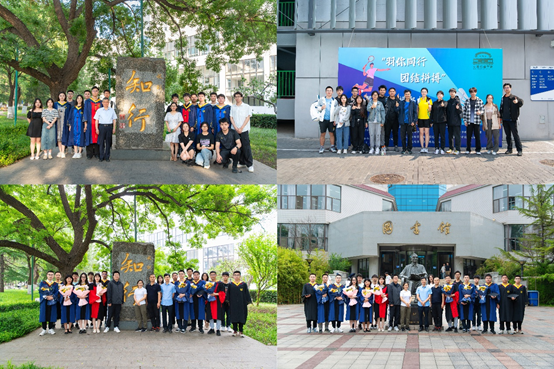
Our research group consistently recruits outstanding doctoral and master’s students. We warmly welcome motivated young scholars from related disciplines—including Transportation Planning and Management, Transportation Engineering, Transportation Organization and Intelligent Control, Integrated Transport Big Data, and Digital Transportation—to join our team!
2. Team Member Profiles

Xingchen Zhang, Professor and Doctoral Supervisor, School of Traffic and Transportation; Chair Professor of the Primary Discipline of Transportation Engineering; recipient of national talent programs and the State Council Special Allowance. He concurrently serves as Chair of the Ministry of Education (MOE) Teaching Steering Committee for Transportation Programs, Member of the MOE Higher Education Evaluation Committee, Chair of the Transportation Discipline Committee of the China Association for Engineering Education Accreditation, Vice President and Chair of the Deans’ Branch of the China Association for Transport Education, Expert Reviewer for Doctoral Dissertations at the MOE Degree Center, and Expert Reviewer for National Natural Science Foundation of China (NSFC) grants and National Science and Technology Awards. Prof. Zhang has received one First-Class National Teaching Achievement Award, two Second-Class National Teaching Achievement Awards, one Grand Prize and multiple First-Class Prizes in Beijing Municipal Teaching Achievement Awards. With over 30 years of research experience in transportation engineering, he has led or participated in more than 50 research projects, including national “863” Program projects, NSFC grants, China State Railway Group projects, and Beijing municipal initiatives. He has published over 100 academic papers in domestic and international journals and conferences, authored the textbook Urban Rail Transit Operation and Management, and serves as a peer reviewer for prestigious journals such as Journal of the China Railway Society, Journal of Tongji University, Journal of System Simulation, and China Railway.

Junhua Chen, Professor and Doctoral Supervisor, Associate Dean of the School of Traffic and Transportation; Director of the National Virtual Simulation Experiment Teaching Center; Deputy Secretary-General of the Higher Education Committee of the China Association of Transportation; Executive Council Member of the Digital Course Resources Research Branch of the Chinese Society of Higher Education; Secretary-General of the Transportation Discipline Committee of the MOE Virtual Simulation Teaching Innovation Alliance; and Member of the National Society for Discrete System Simulation. His primary research focuses on transportation planning and management, with sustained engagement in frontline railway operations research. Recognized as a leading young scholar in railway transport organization—particularly in capacity utilization—he is a core member of the Frontier Science Center for High-Speed Rail at Beijing Jiaotong University. As principal investigator, he has led over 30 major projects, including National Key R&D Programs, NSFC grants, and key projects from China State Railway Group. His work has yielded substantial accumulations of data, models, and algorithms related to transport hubs. He has published over 60 journal papers (including in top-tier international journals such as Transportation Research Part B and leading Chinese journals like Journal of the China Railway Society), authored two monographs, holds five authorized invention patents, and possesses 17 software copyrights. He has received more than ten awards, including the Second-Class Science and Technology Award from the China Local Railway Association and the 2024 Second-Class Progress Award in Science and Technology from the China Association of Transportation.

Bin Xu, Lecturer, School of Traffic and Transportation; former member of the Institution of Engineering and Technology (IET, UK) and the Chinese Society for Computer Simulation. He has extensive professional experience, having worked at Beijing Railway Bureau and Beijing Jiaotong University, and completed an executive secondment at Shenhua Baoshen Railway Group Co., Ltd. His research focuses on rail transit service planning, transport capacity analysis and enhancement, and operational optimization. In recent years, he has participated in numerous provincial- and ministerial-level projects, including National Key R&D Programs, MOE “Science and Technology Support” projects, “973” and “863” Programs, NSFC grants, China State Railway Group R&D programs, and central university basic research initiatives. He has published over 20 academic papers and co-authored six Chinese monographs. As a core team member, he contributed to the development of one national-level Course Ideological and Political Demonstration Course and its teaching team, two national-level quality courses, and one national video open course hosted by Chinese universities.

Zhimei Wang, Associate Professor and Master’s Supervisor, School of Traffic and Transportation. She is a recipient of one First-Class National Teaching Achievement Award and one Grand Prize in Beijing Municipal Teaching Achievement Awards. With over a decade of dedicated research in rail transit operational optimization, she has built a solid foundation and technical expertise in the field. She has participated in more than 10 research projects, including national “863” Program projects, NSFC grants, China State Railway Group initiatives, and Beijing municipal programs. She has published over 20 papers in domestic and international journals and conferences and teaches graduate-level Optimization Theory and Methods and undergraduate courses including Management Operations Research and Urban Rail Transit Operation and Management.

Han Zheng, Lecturer, Department of Urban Rail Transit, School of Traffic and Transportation. He teaches Management Operations Research and Urban Rail Transit Operation Management. His research interests include rail capacity calculation and evaluation, train timetable compilation, AI-driven proactive dispatching for rail transit, and short-term origin–destination (OD) passenger flow forecasting. He has published over 10 SCI/EI-indexed journal articles and independently or collaboratively developed several datasets and software toolkits, including a global transportation dataset, a high-speed railway timetable generation system based on passenger flow analysis, and a high-speed rail simulation driving platform. Recently, he has served as PI on two postdoctoral research projects funded by the China Postdoctoral Science Foundation and participated in multiple NSFC grants, National Key R&D Programs, and China State Railway Group R&D initiatives.

Zanyang Cui, Laboratory Engineer, Experimental Teaching Center for Transportation, School of Traffic and Transportation. He is responsible for undergraduate experimental instruction, notably delivering the Virtual Simulation Experiment on Technical Operations at Railway Marshalling Yards. His research focuses on rail network layout optimization, demand-responsive train service design, and maintenance resource allocation for EMU (Electric Multiple Unit) fleets in evolving rail networks. He has published multiple SCI/EI-indexed papers and co-developed two open-source toolkits for physical rail network modeling, which have collectively surpassed 30,000 downloads and installations. He has also participated in numerous research initiatives, including NSFC grants, National Key R&D Programs, and China State Railway Group R&D projects.
3.Research Achievements
3.1 Representative Publications and Monographs
| Title of the article |
Journal/Conference/Publishing House
|
Publication time |
|
Design and Development of an Integrated Virtual-Reality Training Simulation Sand Table for Rail Systems
|
Information
|
2024
|
|
Multitype Origin-Destination (OD) Passenger Flow Prediction for Urban Rail Transit: A Deep Learning Clustering First Predicting Second Integrated Framework
|
Journal of Advanced Transportation
|
2024
|
| Coordinated transportation organization of heavy-duty railways and heavy empty trains considering vehicle resources |
Journal of Railway Science and Engineering |
2024
|
| Research on the adjustment of high-speed railway train operation chart for transfer experience optimization |
Rail transport and economy |
2024
|
|
Integrated Models and Algorithms for Enhancing Service Level and Capacity Utilization in Railway Operations
|
International Conference on Traffic Engineering and Transportation System
|
2023
|
|
Data-driven train delay prediction incorporating dispatching commands: An XGBoost-metaheuristic framework
|
IET Intelligent Transport Systems
|
2023
|
|
High-speed train timetable optimization based on space–time network model and quantum simulator
|
Quantum Information Processing
|
2023
|
|
Integrated Planning for Depot Location and Line Planning Problems in the Intercity Railway Network with Passenger Demand Uncertainty
|
Sustainability
|
2023
|
|
Research on the distribution model of high-speed railway trains based on neighborhood kernel density estimation
|
Journal of Railways |
2022
|
|
Joint Optimization of Multi-Cycle Timetable Considering Supply-to-Demand Relationship and Energy Consumption for Rail Express
|
Mathematics
|
2022
|
|
A cumulative service state representation for the pickup and delivery problem with transfers
|
Transportation Research Part B: Methodological
|
2019
|
|
Variable marshalling EMU operation and maintenance integration Pareto frontier points divide
|
Transportation System Engineering and Information |
2019
|
| Multimodal network optimization with consideration for feeder transport services |
Journal of Shenyang University of Technology (Social Sciences Edition) |
2019
|
|
Subway passenger flow simulation based on multi-level pedestrian behavior model true
|
Journal of Dalian Jiaotong University
|
2019
|
| Modeling and Implementation of Classical Problems in Railway Transport (Monograph) |
China Railway Publishing House, |
2019
|
3.2 Representative Research Projects
| Project name |
Project Source: |
Project time |
| Shipping operation chart planning services |
National Energy Group Shipping Co., Ltd |
2024-2025
|
|
Development of transportation vehicle flow situation deduction model
|
Beijing Feihong Yunji Technology Co., Ltd |
2023-2024
|
| Railway transport dispatching organization innovation and implementation of technical route research to adapt to high-quality development |
Railway Corporation (formerly Railway Department)
|
2022-2023
|
| Research on the spatio-temporal matching and scheduling of the main transportation channel capacity demand and the active adjustment and optimization technology of the dispatch |
Railway Corporation (formerly Railway Department)
|
2022-2023
|
| Research on the rational matching and coordination optimization of the transportation capacity of the Beijing-Shanghai corridor high-speed railway and the general speed railway line network |
Railway Corporation (formerly Railway Department) |
2021-2022
|
| The high-speed railway network is studied through the theory and method of comprehensive utilization of capabilities |
National Natural Science Foundation of China gold
|
2018-2021
|
3.3 Representative Awards and Honors
| type |
Achievement Name |
Award Name |
reward grade |
Award time |
| Teaching related |
Create a new engineering industry-education integration dual-teacher classroom - "railway driving organization" |
The second prize of the 4th National College Teacher Teaching Innovation Competition in the National Competition of Industry-Education Integration Track |
National |
2024
|
| Famous young teacher in Beijing universities |
Famous young teacher in Beijing universities
|
provincial and ministerial level |
2024
|
| National first-class undergraduate course - Management Operations Research (A) |
National first-class undergraduate courses |
National |
2023
|
| Reform and practice of the construction of the "classified training" system of transportation professionals under the background of new engineering |
Teaching Achievement Award |
National
|
2023
|
| Scientific research related |
Key technologies and applications of urban rail transit operation safety early warning and emergency response in complex environments |
The second prize of science and technology of the China Transportation Association in 2023 |
provincial and ministerial level
|
2024
|
| Construction and simulation system development of complex scenarios for urban rail transit |
Second prize of the 2023 China Local Railway Association Science and Technology Award |
provincial and ministerial level
|
2024
|
3.4 Representative Intellectual Property
| type |
Achievement Name |
Grade number |
Award time |
| patent |
A method and system for identifying and eliminating bottlenecks in railway passage capacity |
ZL201910882261.3
|
2022
|
| Method and system for identifying and eliminating railway transport capacity bottleneck |
2020101782
|
2022
|
| A behavioral perception system and method |
ZL201710186263.X
|
2017
|
| Software copyright |
Deduction and optimization software for coal transport and heavy-duty railways |
2024SR1317794
|
2024
|
|
Dispatch-driven train delay analysis system
|
2024SR0137572
|
2024
|
| Capabilities based on rail transport scheduling utilize an integrated analysis system |
2024SR0137562
|
2024
|
| High-speed railway train operation charting system based on quantum computing |
2023SR0825080
|
2023
|
| Railway channel flow data analysis system |
2021SRBJ1051
|
2021
|
|
High-speed rail through capacity calculation system
|
2021SRBJ0691
|
2021
|
| High-speed railway capacity basic element management system |
2021SRBJ0690
|
2021
|
|
The railway transportation capacity is comprehensively used with a dynamic simulation system
|
2021SRBJ0689
|
2021
|
3.5 Representative Experimental Platforms
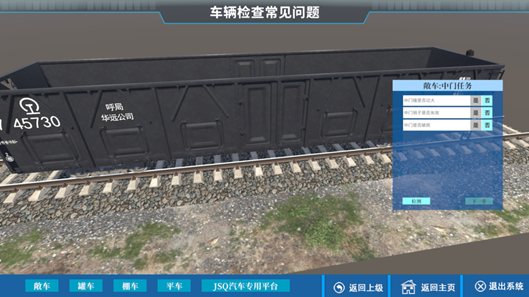
(1) Railway Cargo Inspection Workshop Operation VR Training Platform
The railway cargo inspection training platform, based on the prototype of Fengtai West Station, uses simulation technology to digitally model the cargo inspection process. It includes cognitive videos, virtual learning, and assessment systems supporting both PC and VR modes, allowing students to learn cargo inspection operations in a virtual environment. This system aims to help undergraduate students understand railway cargo inspection work, make up for the lack of on-site visits, and complete their knowledge system.
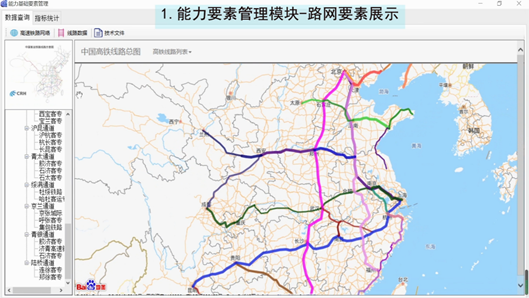
(2) High-Speed Railway Capacity Calculation and Simulation System
Integrating big data analysis with secondary development of OpenTrack, this system provides modular functionalities such as network visualization, capacity index calculation, bottleneck identification, and optimization, meeting multi-level simulation needs. It assists transportation decision-making departments in capacity measurement and pre-enactment of transport plans to improve decision quality and optimize transport planning.
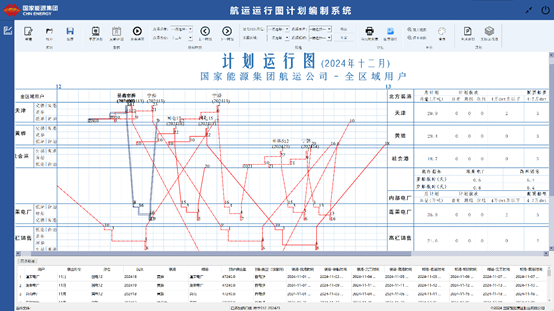
(3) Shipping Timetable System Phase I
Extending railway timetable concepts to the shipping domain, this system designs an element system, technical scales, statistical indicators, and compilation processes for shipping timetables, featuring multi-temporal-spatial scale timetable compilation functions to support digitalization in shipping.
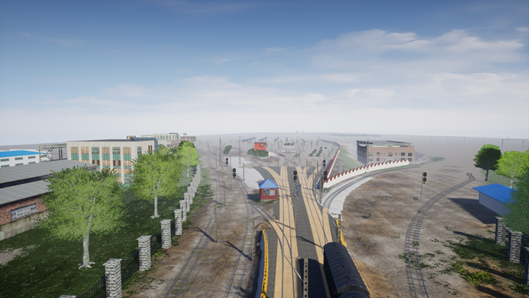
(4) VR-Based Cognitive Internship System for Fengxi Marshalling Yard
Using VR technology, this internship system allows students to roam a virtual marshalling yard via head-mounted displays and joysticks, learn about equipment information, and experience roles like uncoupling staff, shunting driver, and shunting area manager through modular learning.
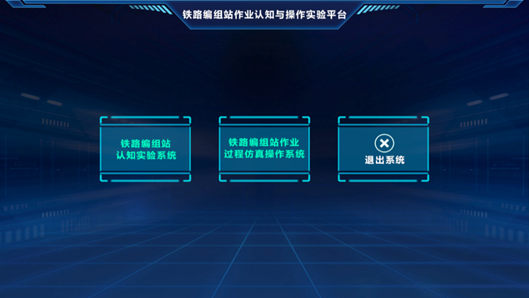
(5) Cognitive and Operational Experiment Platform for Railway Marshalling Yard Operations
Based on the prototype of Fengtai West Station, this platform offers cognitive experiments and operational process simulations to address limitations in student field cognition and practical operation. Through simulation and voice explanations, it helps students become familiar with operational system operations, filling knowledge gaps and completing the knowledge system.
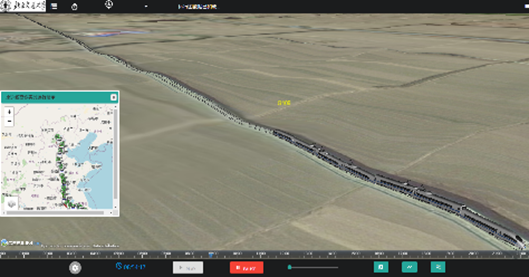
(6) High-Speed Railway Transport Capacity Intelligent Analysis System Based on Digital Twin
Utilizing "digital twin" and GIS technologies, this project establishes an intelligent analysis system suitable for Chinese high-speed railway capacity elements. It effectively leverages data sensing technology advantages for line, section, and station data collection, designs real-time cyclic iterative dispatch command alternatives, builds an optimized capacity analysis model framework, enhances simulation accuracy, and expands display dimensions.
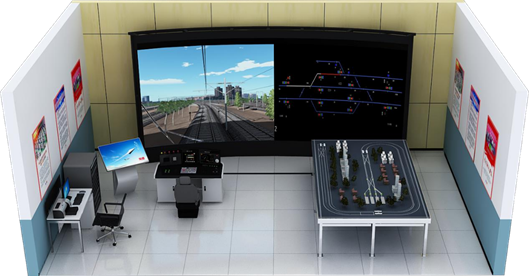
(7) Hardware Sandbox for Train Automatic Control Comprehensive Training Platform
This is a simulation system modeling train operations, consisting of control centers, depots, tracks, trains, stations, and trackside equipment. It simulates route arrangement, train tracking, platform control, and signal control under CBTC mode, including signal fault simulation handling. Combining software simulation and physical demonstration, it helps students familiarize themselves with signal control and operational operations, offering cost-effectiveness and safety while providing cross-disciplinary, multi-position training for students and employees.
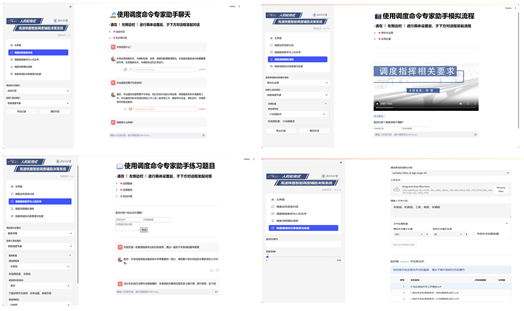
(8) Human-Machine Polling High-Speed Railway Intelligent Dispatching Decision Support System
Featuring natural language dialogue, question bank teaching, dispatch process simulation drills, and knowledge base management, this system effectively addresses diverse and personalized scheduling scenario demands and educational resource shortages through scenario-based drills and dynamic knowledge base updates. It provides an integrated solution for railway vocational education training, industry knowledge dissemination, and dispatch decision support.
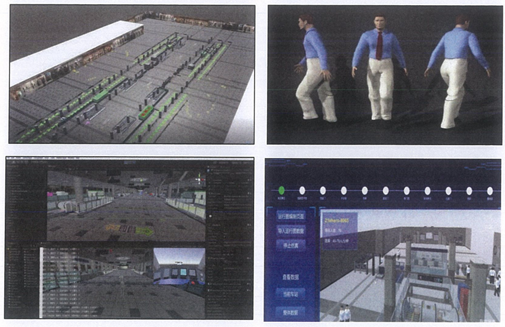
(9) Complex Scenario Dynamic Evolution Simulation System
At the macro level, this system designs controlled-random models for train flows, establishing models for train tracking, delay propagation, and optimal control. Microscopically, it employs VR technology to generate specific scenarios, collecting behavioral responses from participants in certain environments, providing foundational parameters for pedestrian flow simulation. The system can simulate evacuation during large passenger flow fires and train adjustments, achieving real-time interactive functionality among multiple roles, aiding urban rail transit management in making scheduling decisions during daily operations and emergencies.
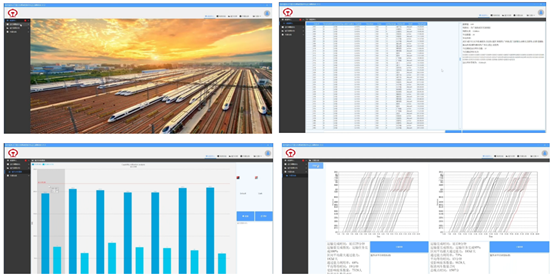
(10) High-Speed Railway Train Operation Adjustment System Aimed at Service Level Improvement
Integrating key modules such as data import, delay information processing, operation adjustment optimization, capacity analysis, and plan comparison, this system rapidly optimizes train schedules under complex operating environments and varied scheduling needs. It provides relevant service level indicators and capacity analysis results in real time, suitable for routine scheduling planning, emergency response, and medium-to-long-term resource allocation strategy formulation, supporting operators in effectively responding to dynamic changes in train operations, improving overall transport efficiency and service quality.
4. Team Contact Information
Contact Person: Zanyang Cui
Email: zycui@bjtu.edu.cns
